
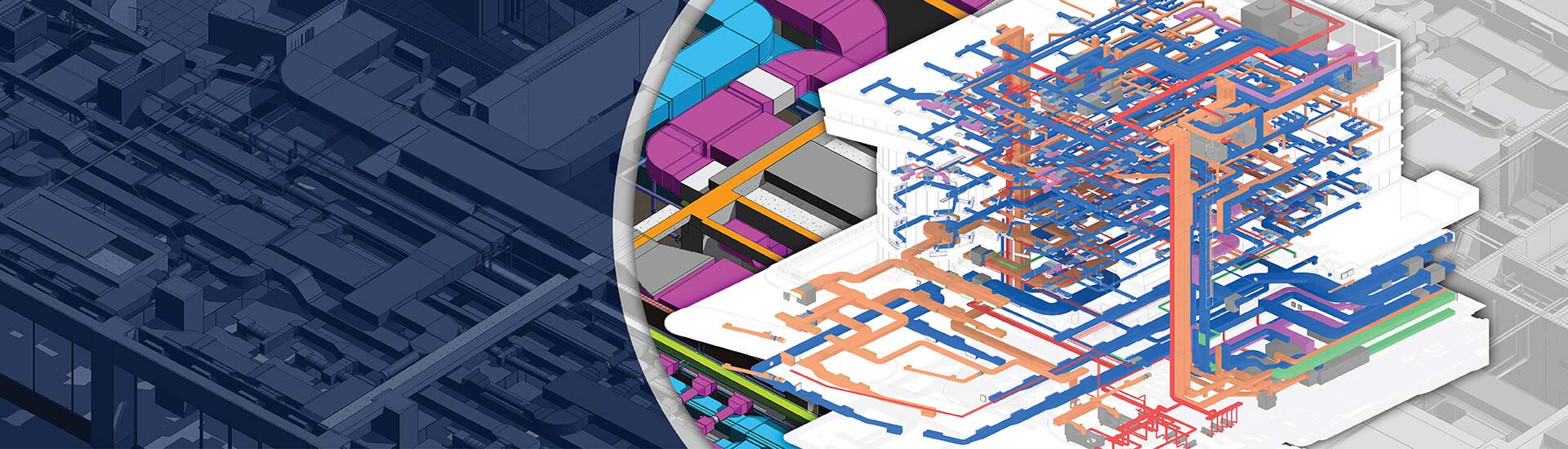

- Legacy spatial coordination leaned on 2D overlays, which failed to highlight vertical heights issues and hidden spatial clashes.
- BIM-based MEP coordination provides 360-degree visualization of MEP systems for greater project clarity, reducing costly onsite rework and improving collaboration between stakeholders.
- A coordinated MEP model helps building engineering consultants, general contractors and specialty contractors get precise spatial validation and early clash detection for timely project completion.
Table of Contents
- Understanding MEP Coordination
- Difference Between Design vs. Construction Stage Coordination
- Why MEP Coordination is Critical in Construction
- Common MEP Coordination Challenges
- The Role of BIM in MEP Coordination
- The MEP BIM Coordination Process: A Step-by-Step Workflow
- How BIM-based MEP Coordination Streamlines Construction
- Top 5 Benefits of BIM-based MEP Coordination
- Future of MEP Coordination with BIM and Digital Construction
- Conclusion
If you are a part of a team working on a new construction project, you would know how sophisticated HVAC systems are. Automation and energy grids are integrated into dense floor plates, which requires accuracy and visualization. Intricate MEP networks demand high performance standards and sustainability.
If high-efficiency conduits are to work as designed, you need to make sure of precise spatial tolerances when installing. But for this you need efficient MEP design coordination, and that is tough when there are disconnected workflows and data exchanges can’t capture accurate spatial overlaps. This coordination breakdown is what leads to design clashes. And if clashes aren’t found and fixed during the design stage, then site teams have to reroute entire systems.
MEP consultants, contractors and other stakeholders can easily automate conflict checks using MEP BIM coordination services. They can even validate constructability of MEP systems through 4D and 5D simulations. Federated MEP models highlight geometric issues and ensure that fabricated components fit seamlessly during installation.
MEP systems plays a critical role in construction and account for 20 to 40% of the total costs.
Source: www.sciencedirect.com/Understanding MEP coordination
MEP coordination is a crucial process of combining various systems such as mechanical, electrical, and plumbing systems into a clash free and federated spatial model. When you use a Common Data Environment (CDE), it spots hard and soft clashes between architectural, structural, and MEP equipment.
Also, synchronizing all the technicalities ensure all the service routes adhere with the design intent, building codes, and maintenance accessibility. This helps improve the building’s internal volume.
Multiple disciplines are involved in the MEP coordination process. The trades involved are as follows:
- Mechanical: Includes spatial routing AHU, ductwork, and chilled water piping. It requires mechanical engineers to develop precise calculations on thermal expansion and clearance zones.
- Electrical: Lighting layouts, high voltage power distribution and cable tray networks are some of the issues that electrical engineers have to manage. Once they are coordinated, electromagnetic separation is achieved and dedicated zones are preserved for control panels and switch gears.
- Plumbing and Fire Protection: Experts from this discipline work on pressurized domestic water lines and gravity-led drainage slopes. It also requires coordination of fire suppression units with electrical and plumbing systems. Strict compliance to spray pattern clearances and hydraulic gradients is required to achieve safety standards.
Based on a general contractor’s observation, coordination costs were around 6% of the total MEP cost.
Source: https://stacks.stanford.edu/Difference between design vs. construction stage coordination
The concept is simple to grasp. For example, for a building engineering consultant, design coordination happens in the pre-tender phase or the design stage. The focal point involves schematic alignment as well as the system verification within the architectural layout.
Construction stage coordination includes fabrication ready LOD 400 models and shop drawings for subcontractors. A specialty contractor relies on construction to account for tolerances, hangers, and installation sequences, which can save rework and reduce change orders.
Why MEP coordination is critical in construction?
The prime directive of MEP coordination is removal of spatial conflicts in a federated Revit model. When utility pipelines and wiring within spaces above ceilings are nonstandard, it requires advanced MEP coordination. It can also help your company reduce risks related to clashes and geometric interferences in construction projects.
A federated and clash-free MEP BIM model helps stakeholders implement planned design tolerances and coordinate architectural, structural and MEP disciplines for higher structural integrity.
- Avoid design interferences: Advanced spatial resolution highlights geometric overlaps between MEP routes and structural framing. It avoids compromising design tolerances within an architectural layout.
- Reduce rework & delays: If you use a federated 3D model, it helps you remove field-based changes and ensures construction sequences stay on schedule.
- Improve cost control: When stakeholders are able to identify clashes in Navisworks during preconstruction, it reduces costly change orders. Also, specialty contractors can mitigate material scrap which stems from unauthorized rerouting.
- Enhance construction efficiency: BIM data that is coordinated with precision can help modular assembly and offsite prefabrication. A building engineering or general contracting firm can leverage plug and play installation with a reduction in site footprints.
- Ensure code compliance & safety: If a building engineering consultant incorporates algorithmic checks, it can help them verify electrical clearances and pressurized systems for hydraulic gradients and NFPA safety.
Common MEP coordination challenges
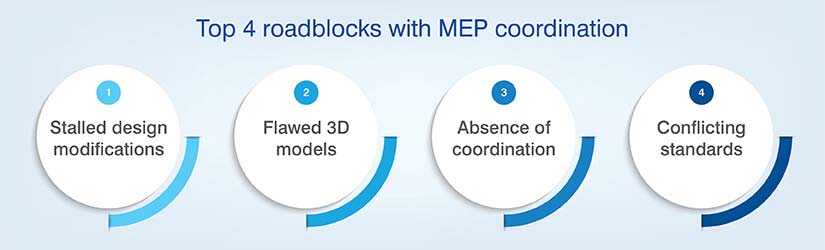
It is not easy to coordinate multiple architectural, structural and MEP systems and make them work together. Here are some common challenges faced by stakeholders during the MEP coordination process.
- Delayed design changes: If architectural and structural modifications or changes are done at a later stage, they disrupt MEP routes and cause secondary geometric failures.
- Inaccurate models: You will face false spatial security if there are deviations in the As-Built model. It will also lead to hard clashes within prefabricated products during onsite work.
- Lack of coordination: If all the teams are not working in a coordinated framework or workflows are siloed, it will force rework to occur on the field.
- Inconsistent interdisciplinary standards: Building engineering consultants who do not apply the right Level of Development (LOD) standards and BIM protocols will face interoperability issues. It will also lead to inaccurate interference checks.
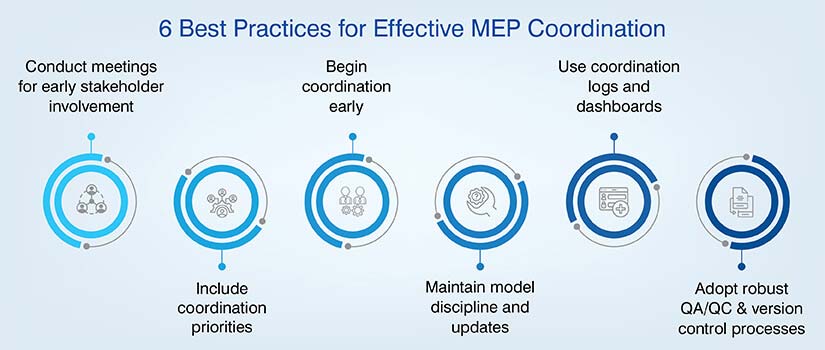
A single mistake can take the process off-course or if best practices are not used, it can cause obstacles For this, it is important to follow best practices for MEP coordination that have been illustrated further in the article.
The role of BIM in MEP coordination
BIM acts as a centralized digital space where various trades including mechanical, electrical, and plumbing are combined geometrically using algorithmic clash detection in Navisworks. By using BIM building engineering consultants, general contractors and other stakeholders enable high data synchronization among the various disciplines.
- 3D visualization for service routing: High-fidelity 3D models ensure spatial alignment within dense MEP equipment. It helps improve service gradients and opens up zones for maintenance access before prefabrication starts.
- Automated clash detection: When firms incorporate Navisworks in the process, it surgically flags system overlaps. It can also point out clearance violations across a federated model. This can resolve thousands of site conflicts in a digital space.
- Model-based documentation: Once the 3D model is validated, we can generate shop drawings at LOD 400. This helps synchronize documentation with updates and removes any dimensional ambiguities.
- Integrate construction sequencing (4D BIM): Building engineering consultants can link the coordinated MEP model to the project schedule and run temporal simulations along with visualization, avoiding stacking and logistical issues. This also ensures that large MEP equipment is placed before structural enclosures begin.
By adopting a BIM/VDC model, projects can get 20% – 30% in labor savings, reduced re-installation, and mitigated conflicts.
Source: https://pmc.ncbi.nlm.nih.gov/The MEP BIM coordination process: A step-by-step workflow
The BIM coordination process is crucial and requires a streamlined workflow. Here is 5-step process to ensure an accurate and precise coordination process.
Model preparation and data alignment
You need to conduct a forensic audit of the documentation to highlight geometric inconsistencies. Also, the geometry in the 3D model needs to be verified with required engineering intent.
When a firm is developing a 3D model, it needs to set parametric controls and define an LOD to ensure model fidelity. After this is done, it is important to align the BEP with multi-trade workflows for data exchange and accountability.
Discipline-wise BIM modeling
Develop high performance parametric elements that contain fabrication-ready geometry and incorporate manufacturer centric data for validation.
And we need accurate routing for gravity and pressurized systems while preserving the clearance buffers for insulation thickness and thermal expansion.
Federated model integration
Combine disparate models from various disciplines into a single model for spatial validation and reveal geometric issues.
When you can successfully define a categorized spatial matrix that allocates plenum volumes to various disciplines, it analyzes gravity flow needs and system criticality.
Clash detection and resolution
Integration of algorithms when incorporated, can filter geometric overlaps and clearance violations in the federated model. Cloud-driven platforms ensure that every interference gets a unique ID, priority, and resources needed to resolve these issues.
Running sequential model updates and clash audits can help your team refine spatial arrangements until the entire MEP network is reconciled for prefabrication of MEP equipment.
Validation and final coordination sign-off
Your project lead will run a forensic audit of the federated model to check all the conflicts are resolved to lock geometry. The validated LOD 400 model is approved, and extraction of shop drawings is initiated for remote fabrication.
How BIM-based MEP coordination streamlines construction
MEP coordination makes the construction process seamless with spatial validation and clash resolution in digital space. It eliminates logistical resistance on the site and ensures precision-led installation sequences.
- Clash-free construction: You need to preserve original design tolerances and ensure high-density MEP systems are interference-free. When the 3D model is free of errors, it ensures the installation sequences are following a critical path.
- Improved constructability: Integrated spatial validation ensures that architectural constraints align with structural tolerances. The use of BIM clash detection can verify dedicated clearances for MEP equipment serviceability and valve access.
- Reduced RFIs and rework: 3D spatial arrangements if engineered correctly, can help the installation team get error-free routing. This ensures MEP services fit within structural layouts. When digital resolution is proactive, it shifts the mindset from onsite work-around to controlled preconstruction.
Top 5 benefits of BIM-based MEP coordination
When a digital-first methodology is applied to MEP coordination, it provides unmatched constructability and streamlined installation. Stakeholders can secure their timelines and budgets from the volatility of onsite rework.
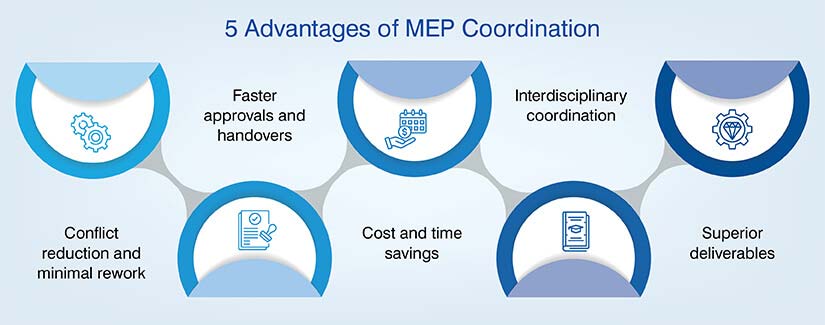
The following are 5 benefits that show the impact of BIM on MEP coordination:
- Clash reduction and mitigated rework: Navisworks makes detection of clashes simple and quick. When conflicts are detected during preconstruction, it gives building engineering consultants, general contractors, and others time to resolve them in digital space so the project is not affected by high material waste and idle labor.
- Quick turnaround time: If the data exchange is synchronized in a CDE, it helps speed up review cycles by replacing 2D overlays with real-time validation. This increases the velocity of movement from design to fabrication and construction.
- Time and cost savings: As you begin to mitigate geometric overlaps in virtual space, it prevents change orders and keep construction sequences on schedule. BIM MEP coordination makes sure your projects are profitable and predictable.
- Collaboration improvements between disciplines: When BIM is incorporated, it dissolves silos using a single source of truth. BIM makes sure every system within the architectural layout work in harmony backed by high data interoperability to streamline work and solve issues.
- High quality systems: Model coordination makes sure all the systems follow a route with optimal gradients. When hydraulic efficiency, system performance, and maintenance accessibility is optimal, it ensures error-free installation.
Coordinated and clash-free 3D model for a hospital project saves cost and time.

An engineering contracting firm from Ireland joined hands with HitechDigital for a healthcare project. The project was quality sensitive, and errors would have resulted in costly iterations, material waste, extended schedules. Also, the project had to be finished within planned timelines.
The team at HitechDigital was given 2D basic and markup drawings as input. After careful assessment, the team used Revit to develop HVAC and plumbing models as per project standards and space needs. Also, Revit families were created based on the data-sheet provided by manufacturers. This would have led to accurate spatial coordination.
The model was clash tested in Navisworks and the conflicts were resolved quickly. The final 3D MEP model was used to extract shop drawings, BOQs, builders works drawings, and other deliverables. To ascertain model accuracy, the team ran multiple QA/QC checks. Files were stored on BIM360 for all the stakeholders to access and make necessary changes.
Upon deliverable handover, the client could:
- Achieve swift installation of MEP equipment using shop, module, and spool drawings.
- Leverage 98% FTR deliverables.
Future of MEP coordination with BIM and digital construction
The future of MEP coordination will lean toward AI-driven workflows that are autonomous ecosystems. These systems will help your firm negotiate spatial constraints through proactive methods. Right now, we are looking at possibilities of self-healing generative 3D models with algorithmic conflict detection.
With further development of model led planning, we expect to synchronize designs with fabrication in real time. Once that is achieved, it will shift digital construction toward zero-latency integration. This can redefine inter-trade synchronization and paradigms of productivity at worksites.
Conclusion
In modern projects, MEP coordination is crucial because everything associated with urban lifestyle, whether it is energy savings or occupant safety depends on it.
However, the biggest issue is that without the detection and resolution of design clashes it is extremely difficult to implement inter-disciplinary coordination. Clash detection tools like Revit and Navisworks, however, have opened the door to full leveraging of BIM and digital design workflows in construction projects.
We take guesswork out of your next MEP project.
Let us handle the heavy lifting to resolve your spatial issues with complete confidence and ensure a first time fit.