


- Real estate data cleansing is an ongoing process requiring regular monitoring, as data quality deteriorates quickly without consistent oversight.
- Poor-quality data accumulates rapidly and cannot be effectively managed through automation alone or without active intervention.
- Scalable data cleansing requires a balanced approach combining advanced tools, domain expertise, and human validation for optimal accuracy.
Table of Contents
- Why real estate data gets dirty: 6 root causes
- The business cost of inaccurate real estate data
- Core real estate data cleaning strategies
- Address standardization and geocoding validation
- Cross-validating property characteristics
- Verifying transaction histories against deed records
- Handling missing property data: MCAR, MAR, and MNAR
- Outlier detection: MAD and the Hampel identifier
- Automated data consistency checks at ingestion
- Data governance: lineage, roles, and access controls
- AI-Powered real estate data cleaning for high-volume databases
- Real estate data cleaning workflow: sequence matters
- GDPR, CCPA, and real estate data compliance
- Frequently Asked Questions
- Conclusion
Poor data quality costs organizations an average of $12.9 million every year, as estimated by Gartner while a $3 trillion annual drain is estimated by Harvard Business Review. This accounts for huge loss and pushes you to implement data cleansing strategies.
The consequences of real estate data errors in your system show up as valuation errors, duplicate listings, delayed transactions, mis-priced assets, rejected applications, monetary losses and wasted marketing efforts.
Even giants like Zillow can fail to accurately model real-world property dynamics. The failed Zillow Offers initiative, where the company recorded write-downs of up to $569 million and laid off around 25% of its workforce, remains a stark example of the ravages of data management pitfalls.
Real estate data hygiene is quite different from generic data cleaning. It involves various datasets pertaining to real estate like geospatial accuracy, listing descriptions, transactional history, deed records, tax databases, county assessor records and other sections pertaining to real estate.
Data cleaning in real estate is a systematic process where each of the datasets need to be critically evaluated by domain experts from the field. This is not a standard database task.
This guide covers real estate data cleaning strategies both basic and AI/ML-powered techniques. For teams managing real estate data aggregation pipelines at scale, downstream reliability of data depends on the sequence and selection of these data cleaning strategies.
Why real estate data gets dirty: 6 root causes
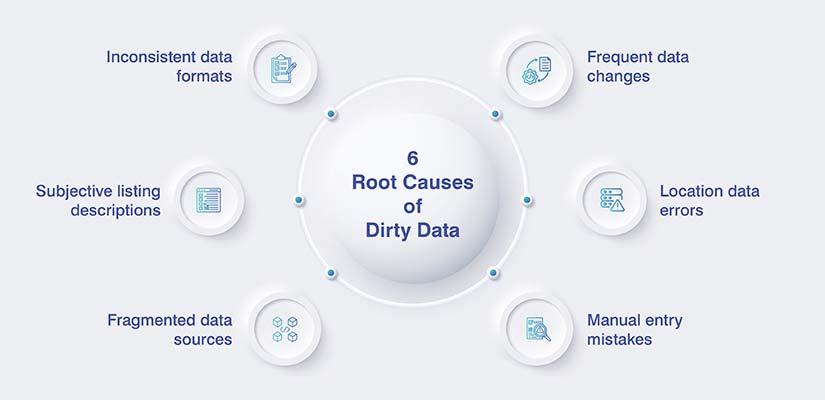
Before you start fixing data errors, you need to understand the source of errors. It is a prerequisite to the cleaning process. Each type of error originates from a different process failure and to fix them, you need to approach them differently. Here are the 6 root causes for dirty data:
-
Non-standard formats across sources – Real estate data is collected from multiple sources like listing sites, county records, aggregators and since each stores data in different formats, this results in inconsistent formats. To illustrate with an example – 2 BR / 1 BA, 2 bed, 1 bath, and Bedrooms: 2 describe the same property attribute.
This needs normalization before it is integrated into the system. Otherwise, you can get failed record matching in multi-source pipelines.
-
Subjective property descriptions – A property can be described in multiple ways based on the person describing it and it often gets subjective. Say if there is a beautiful property, the description could vary – like beautiful, move-in ready, pleasant or some may even describe it as cozy.
There cannot be any standardization for such terms. Structured attributes are easy for NLP models, but this kind of description doesn’t help with property segmentation.
-
Fragmentation across jurisdictions – Property data in US varies by county. Each area has its own format for parcel IDs, zoning, and tax records. Due to lack of any single standardized national system, when data from different zones are combined, it results in inconsistencies and mismatches.
-
High update velocity – Real estate deals with dynamic data that keeps changing at a very fast pace. Listing status, pricing, ownership and even sometimes zoning classification change. Without real-time data updates, the data does not remain accurate and reliable. Periodic batch processing does not work with real estate data.
-
Geospatial inconsistencies – Location coordinates sometimes differ for the same property because of the different sources used to collect the data. If you are not careful, these small differences can place the property in wrong area. And if the location is wrong, all other data like pricing, tax or risk assessment may all go wrong.
-
Data entry errors and misrepresentation – Manual data entry can lead to major mistakes. Even a small typo can list property with the wrong valuation, or sometimes the same property may be listed multiple times. We need automated validation to prevent such errors from affecting the entire database.
The business cost of inaccurate real estate data
If you think that data quality is just a technical issue, you need to reconsider. Today, no property business can afford to underestimate the importance of high-quality real estate data for their business.
Your automated valuation models (AVMs) need accurate data to estimate property value using data and algorithms. It does not require any manual intervention, but the input data must be accurate. Even a minor error in the transaction prices can lead to big valuation mistakes affecting REITs, iBuyers, and lenders. If you use AI and ML services on property data, input data quality is critical for model accuracy.
Accurate contact and ownership data is important for real estate marketing platforms like Salesforce, HubSpot, and Propertybase to manage campaigns and conversions. Any error in the data like wrong ownership, duplicate records etc. increases the marketing costs and reduces conversions.
Maintaining compliance and following laws like CCPA and GDPR require accurate personal data. Any inaccuracy in personal records or ownership details can lead to compliance risks.
It is important to check data at the entry level itself rather than cleaning it later. It costs much less when you fix the data issues early, rather than fixing later.
7 Core real estate data cleaning strategies
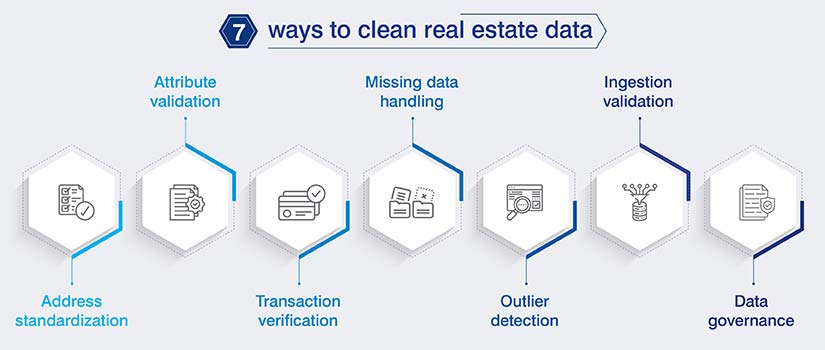
Here are a few proven ways that help you create the basic data quality foundation required for any AI system to work effectively.
1. Address standardization and geocoding validation
Addresses link records across different real estate sources. It is the primary key that connects MLS, assessor, and tax databases. And if the address formats are not standardized and validated the records don’t match correctly. The strategy to avoid this would be to standardize property addresses. It is a good idea to break addresses into parts like street, city, state or ZIP.
And finally, do a complete address validation using reliable sources like Census or county GIS data. For teams requiring cleansing and validation of data at scale, real estate data cleansing and enrichment services can implement CASS validation as a pipeline stage rather than a onetime fix.
2. Cross-validating property characteristics
Validate property characteristics, like number of bedrooms and bathrooms, year built, and square footage, across at least two reliable sources. You could use county records and MLS listing to validate the records. If you find any discrepancy of more than 5% flag them and review before finalizing the data.
You can also apply basic logic, like a 500 sq.ft. house cannot have many rooms. Any inaccuracy in the data can distort analytics and valuations, making your listing unreliable.
3. Verifying transaction histories against deed records
Data like sale price and transaction date needs to stay accurate all the time. There should not be any discrepancy between what you have listed and what is mentioned in the official records, like tax filings and county deeds. First, verify your data against that of reliable official sites.
You can also apply common sense to check whether timeline makes sense and the price per sq. ft is as per the rates prevalent for the location. Keeping your data accurate prevents wrong pricing and transactions, ensuring reliable analytics.
4. Handling missing property data: MCAR, MAR, and MNAR
Missing data cannot be handled randomly. You need to follow a structured method and understand why the data is not there. Once you get to know the reason for the missing data, then using an appropriate approach you need to add the missing data.
There are different types of missing data. Use the right method to fix the errors.
- MCAR (Missing Completely at Random) – Random data missing showing no pattern. Use average (mean/median) to fix this.
- MAR (Missing at Random) – Data is missing but related to other factors. Estimate using related data to fix.
- MNAR (Missing Not at Random) – Data is missing intentionally or due to a specific reason. You can use human judgment to fix this.
5. Outlier detection: MAD and the Hampel identifier
Methods like z-scores don’t work well for finding unusual values in property prices. It is always a good idea to use MAD (Median Absolute Deviation) or the Hampel method. These algorithms can spot unusual prices from the messy real-world data. And when you find any outliers, don’t delete them, just flag them for further review. A domain expert can check and verify whether the high price is an error or maybe a genuine high-value transaction.
6. Automated data consistency checks at ingestion
It is important to check the data quality at the entry level itself. If you ignore it at this stage and then once the problems appear, it will get messy, complicated, and cost more. You can set rules to check for invalid or illogical dates, property types not matching zoning and other structured rules.
Tools can be used to help define and enforce these rules at the entry stage. You can always opt for data validation and verification services that offers expert services and helps keep your data consistent and reliable.
7. Data governance: lineage, roles, and access controls
Data governance plans a structured process that ensures data cleaning keeps happening in an automatic and set manner without needing to repeat the process. It involves multiple things as assigning responsibility for each type of data, that ensures ownership. Also, keeping track of data from the entry to its movement across systems.
Tracking and user governance also controls who can edit the data so that the cleaned records are not overwritten. These assume greater importance your data grows, and when just manual checks or basic rules become insufficient. Advanced systems help handle such huge datasets.
AI-Powered real estate data cleaning for high-volume databases

Here we list some advanced techniques used for heavy cleaning of real estate data. They are not a replacement for basic techniques. These are additional advanced techniques for data where manual checks or rules don’t work.
Anomaly detection with Isolation Forest and One-Class SVM
Sometimes in large datasets it gets difficult to find unusual records. And then there is a need for advanced AI methods like Isolation Forest or one-class SVM. These advanced techniques can scan huge volumes of records and identify small percentage of errors that is not possible to check manually.
These algorithms can pinpoint the 1–2% of records that create most issues. Isolation Forest can track records that is unique while one-class SVM flags any data that doesn’t match clean data. AI-based anomaly detection can find high-impact errors that is not possible manually or with traditional methods.
Clustering for intra-group consistency
Clustering data into groups based on factors like location, size, type etc. is important for real estate records. It helps with an easy comparison of properties within the same segment or cluster. And it also flags any data if it doesn’t align with the cluster for further review. This ensures properties are compared with similar ones and improves analysis and valuation.
NLP for extracting structure from listing descriptions
NLP helps extract real estate structured attributes from unstructured descriptions. Often property descriptions are written in free text, and then NLP extracts useful and required information from the descriptions. NER (Named Entity Recognition) identifies details like renovation status, number of bedrooms and bathrooms, etc. that helps understand the whole set-up. Especially when the sources don’t provide proper fields.
Geospatial AI for location data cleaning
Geospatial AI helps clean and fix location data in property records. Techniques like address parsing and fuzzy matching fixes typos and any format issues with the address. Spatial clustering detects any wrong coordinates, while spatial interpolation fills in missing location details using nearby properties.
This ensures properties are mapped to the correct location and improves location-based analysis. There is no scope for any errors caused by simple distance-based guesswork.
Active learning to compress the manual review queue
Active learning is a great technique that helps reduce the role of manual data reviewers. The model picks or flags the uncertain or borderline cases, and that is later reviewed by human experts. The model learns from each correction and gradually gets trained better. And eventually the number of reviews also reduce.
This cuts manual review workload by almost half, and experts can focus on other core issues.
Ensemble methods for multi-layer data quality scoring
To tackle all kind of data errors, a single technique or algorithm may not work. Multiple techniques are combined to improve data score. The outputs from different methods like anomaly detection, clustering and NLP are each given a overall quality score. Any low-quality score goes for review while a high score is approved for use.
This kind of method works best for complex and multi-source datasets and gives much better results than using a single model.
Real estate data cleaning workflow: sequence matters
It is important to follow the right order in your data cleansing project. Not maintaining the right order can add errors instead of fixing them. Here is the path that you must follow.
- Data Profiling – Check for data quality first. Look for duplicates, formatting issues, and missing values for each source separately.
- Source Authority Ranking – Assess the reliability of data source; it could be scraped data, MLS or county records. The most reliable source must be used if there is any data conflict.
- Address Standardization – Normalize and standardise all address fields before any validation or data merge.
- Deduplication – Identify duplicate records and merge using fuzzy logic. Any inconsistency or doubt must be flagged. Never delete any data blindly; keep source information.
- Missing Value Imputation – After duplicates are removed, fill the missing values using appropriate methods like MCAR / MAR / MNAR.
- Outlier Flagging and Expert Review – Flag any unusual record for domain expert review. Don’t delete without review.
- Ongoing Validation – Keep validating records on a continuous basis. Data cleansing is not a onetime process.
GDPR, CCPA, and real estate data compliance

Data privacy and protection is very important in real estate data as personal data is also involved. There is personal information about the owner’s name, contact details, purchase history and demographic inferences. GDPR and CCPA have strict regulations that must be followed.
The law requires that all records pertaining to individuals must be located wherever they are stored and deleted. Even cached records should be removed to maintain the privacy of the owner or buyer. You should be able to track the data source and where the data was used to be able to delete the data completely.
Keep the data you need for your purpose. There’s no point in storing any extra or unused fields. This will reduce legal and compliance risks, lower storage costs and help with easy data management.
Be clear about the data usage when you collect through web scraping. Document it well so that, if need be, you can present the proof. For every data source, you must have a legal purpose. You cannot use personal data freely as per GDPR. And this rule is actively enforced across many countries and jurisdictions.
Maintain audit logs for all actions on property records with personal data so that you can present these logs if you are questioned by regulators.
Frequently Asked Questions
How often should real estate data be cleaned?
The frequency of cleaning your data depends on your data volume, complexity, and how often you add data to your listings. Since real estate data like rentals change frequently, it should be run through automated validation at every ingestion cycle. Quarterly database audits and new audits accompanying any major source integration or structural schema change helps keep the data clean.
What is the most common error type in MLS data?
Address formatting is very important because if address format is inconsistent across different regional MLS boards, it can create fail in multi-source aggregation. All property addresses must have the same format. Formatting discrepancies must be addressed as well as duplicate listings. Formatting discrepancies and duplication are two common errors we need to handle.
What is the difference between data cleaning and data enrichment in real estate?
These are two completely different things. Data cleaning handles errors found in the existing dataset. Data enrichment, however, adds new attributes from external sources to the existing data. Though these methods belong to the same data cleansing and enrichment pipeline, they serve distinct functions.
How are duplicate property records handled across multiple MLS systems?
Duplicate property records are caught by comparing records from different MLS systems. Data like standardized addresses, Parcel IDs, and property details are compared against each other during data cleansing. We take care that matching records are merged, not deleted. This is done to preserve source information and prevent data loss. Having full traceability of any data helps in further additions or deletions.
Which tools validate real estate addresses at scale?
There are many tools like SmartyStreets, Melissa Data, and the USPS CASS API that work well for US addresses. For global coverage you can use tools like Google Maps Geocoding API and HERE. SmartyStreets or Melissa Data are known industry standards for property databases that require CASS certification for downstream use. But these do have their limitations, and it is always a good idea to outsource the validation part. Human experts running automated tools will increase accuracy and rectify errors that can often be missed by tools alone.
How do you validate geospatial data accuracy for property records?
To ensure geospatial accuracy, we cross check the data with reliable sources like county GIS, cadastral maps, or census datasets. We match geocoded coordinates to standardized property addresses and then check for boundaries. We check and ensure that the property falls within the correct ZIP code, city, and administrative boundaries. And then compare results from different sources to identify discrepancies.
Conclusion
Real estate data is complex and dynamic data that needs constant checking. Sourced from multiple sources, in different formats, and a lot of inconsistencies makes data cleaning is essential for real estate records. Also, in real estate, the pricing, rent structure, valuation, and compliances all require records to be accurate and in a consistent format.
Data cleansing is a complex process that requires a correct sequence to be followed. Tools alone will not be enough. The entire process works in combination with tools, automation, and human expertise. Domain knowledge is extremely important for managing a clean real estate dataset. Compliance is another factor that requires correct handling.
Outsourcing to experts who have domain experts combined with the advanced tools and technology proves beneficial for anybody looking for a clean real estate dataset.
Optimize your property data collection
Enhance your real-estate data processes with our expert solutions.