


- Data is one of the most valuable business assets.
- Poor data affects business function, including operations, sales and compliance.
- Data cleansing helps organizations maintain accurate and consistent data across systems.
- Data cleansing is not a one-time project; it is an ongoing business discipline.
Table of Contents
If your campaigns are not getting the right response and emails are bouncing, then before pulling your sales team audit your b2b data. There may be an urgent need for data cleansing.
Data that does not lead to insights is just noise, costing organizations an average of at least $12.9 million annually. Poor data quality continues to impact business performance, prompting many organizations to invest in data cleansing services to improve the accuracy, consistency, and reliability of their business data.
B2B contact data has a shelf life. As per industry reports, the data decays between 22.5% and 70.3% annually. Job changes, mergers, invalid email addresses, and business relocations are some of the factors that affect data quality. This impacts marketing performance, compliance efforts and decision making.
Clean data is the answer to many hidden business challenges. Apart from improving database accuracy, clean data influences revenue and sales performance.
In this blog, we discuss the top five reasons why B2B companies should prioritize data cleansing and how maintaining high-quality business data supports long-term growth.
Why B2B data cleansing matters?
Data cleansing matters because the entire b2b business operations depend on data. The sales, marketing, customer engagement and business decisions, all are data dependent.
B2b data decays at a very fast pace. With decision makers changing organizations, mergers happening and companies relocating, your data requires regular updates. If data cleansing is not treated as an ongoing initiative, very soon the database becomes inaccurate, duplicates, inconsistencies creep in, and outdated data leads to campaign failures.
The business impact of poor data quality can hit business in a big way. The following statistics from Experian Data Quality Research demonstrate how inaccurate data affects organizations.
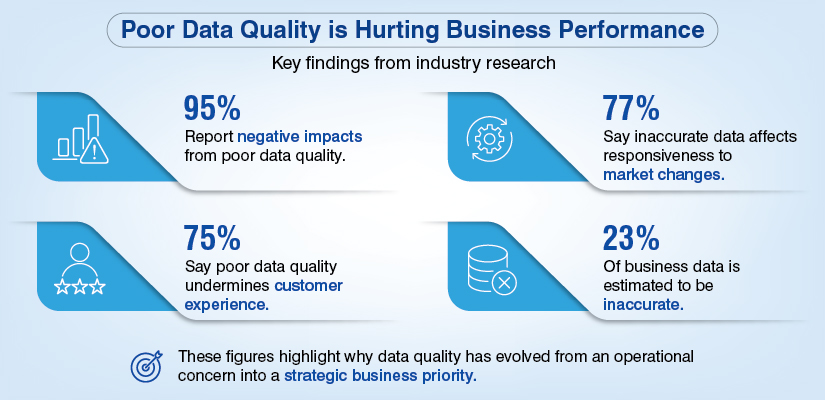
These numbers demonstrate that data quality is no longer an operational concern. It directly affects growth, customer experience, responsiveness, and revenue performance.
Every business function whether it is targeting, segmentation, campaign execution, prospect outreach or pipeline management, all depends on data accuracy. When data quality declines, every function suffers.
Data cleansing helps organizations identify inaccurate data, remove duplicates, validate and update records and standardize formats. It transforms raw data into reliable business intelligence.
Top 5 reasons B2B companies should prioritize data cleansing
As businesses rely more on data, accurate and reliable information has become essential for staying competitive. The following five reasons explain why data cleansing should be a strategic priority for every B2B organization.
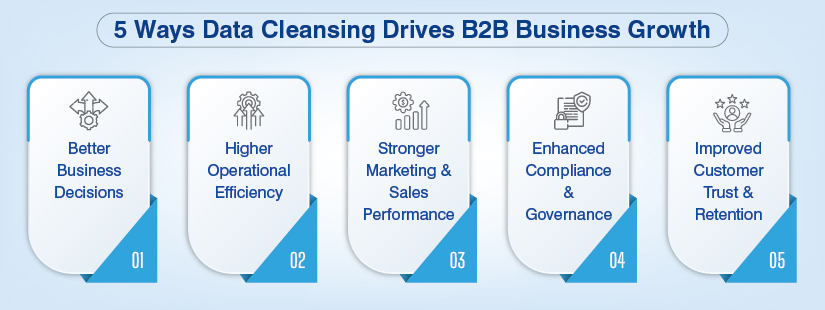
1. Improves data accuracy and business decision-making
Data accuracy is extremely important for any b2b business decisions. Whether it is operational or strategic, dirty data can lead to flawed decisions and revenue loss.
Organizations mostly work on acquired data that may not have been updated in years. When every strategy, planning, customer engagement and operational decisions are based on data, the accuracy becomes paramount. Inaccurate data leads to unreliable reports and analysis. Even your most sophisticated analytical tools will give you flawed results.
How poor data impacts decision making
| Data quality issue | Business impact |
|---|---|
| Duplicate records | Inflated customer counts and inaccurate reporting |
| Outdated contact information | Incorrect targeting and missed opportunities |
| Missing data fields | Incomplete customer insights |
| Inconsistent data formats | Reporting and integration challenges |
| Invalid records | Unreliable forecasts and analytics |
That is why data cleansing plays an important role. It is a critical business function and not just routine maintenance activity.
Data cleansing process involves identifying and removing duplicate records, validating information, standardizing formats and updating and enriching data. It is not possible to manually manage the data cleansing process without technology.
Automated validation tools verify data against predefined rules and sources to identify any kind of inaccuracy. Duplicate detection can be managed efficiently using machine learning algorithms while data standardization platforms convert data formats into a uniform structure.
Apart from these CRM data quality monitoring can keep a check on data quality and data enrichment solutions can enhance data quality.
Accurate data creates a strong foundation for business intelligence. A clean data helps businesses with reliable reporting, better forecasting, correct decisions and confidence in campaigns.
2. Enhances operational efficiency
Every business function depends on data to perform daily operations. If your databases contain duplicates, errors and invalid data, your team would be spending more time in correcting records and less on productive work.
Even a minor quality issue can multiply across thousands of records impacting operational efficiency. Poor data quality affects operational efficiency in several ways. It reduces employee productivity and leads to duplicate efforts across teams.
With inconsistent information across systems, the business process slows down and even customer resolutions get delayed. And most important automated workflows also don’t function accurately.
Poor data quality affects automation in several ways. Automated workflows often fail or produce inaccurate outcomes due to missing, duplicate, or outdated records. Other automation challenges caused by poor data quality include:
- Unreliable CRM automation
- Marketing automation targeting the wrong audience
- Misleading reports and dashboard insights
- Delays in order processing workflows
- Failure of customer service automation
- Underperforming AI and machine learning models
- Increased manual intervention and rework
That is the reason data cleansing is important to improve operational efficiency. When issues like duplicates, inaccuracies or incomplete data are corrected, the workflows get more streamlined and support automation initiatives.
Data cleansing improves operational efficiency by creating a reliable foundation for automated workflows and business processes. Today, businesses increasingly rely on automation, but automation can be effective only if the data quality is good.
Clean data improves CRM and ERP performance and supports workflow automation.
3. Increases marketing and sales effectiveness
You may have hired the best sales and marketing team and with the best of strategies the campaigns are still failing. The issue is lack of well-built and accurate b2b data. Without accurate b2b data, the sales team can’t function properly.
Poor data impacts marketing and sales in multiple ways. Invalid email IDs can lead to high bounce rates; incorrect job titles can lead to wrong targeting while duplicate entries lead to wasted efforts and damage credibility.
The team depends on data to identify prospects, personalise, segment and target. And if the sales team can’t get leads and conversions, the revenue drops.
Therefore, having clean data is directly related to revenue. You provide good quality data to your team, and they will surprise the organization with good leads. Businesses must clean up the database for better segmentation, personalization and targeting so that there are fewer missed opportunities.
How clean data improves marketing and sales performance
| Area | Impact of clean data |
|---|---|
| Audience Segmentation | Better targeting. |
| Lead Scoring | Higher-quality leads. |
| Account-Based Marketing (ABM) | Stronger account engagement |
| Sales Outreach | Improved sales productivity |
| Campaign Performance | Higher conversions |
| Revenue Attribution | Better marketing ROI |
4. Strengthens compliance and data governance
Maintaining a b2b database involves multiple processes like data collection, storage and data usage. But every process must follow the regulatory requirements. And to maintain compliance, data must be clean. That is the reason data cleansing is important for b2b databases to stay compliant.
Organizations must be extremely careful while handling large volumes of prospect, customer, supplier and business contact details. If the data collection, storage and usage is not aligned with regulatory requirements, the businesses can face financial, legal and reputational risks.
The reasons compliance is critical for B2B companies include:
- The sensitive information must not be misused
- Safety from data breaches
- Responsible use of data by regulations such as GDPR and CCPA
- Strict adherence to privacy laws
- Communication with contacts with consent
- Non-compliance can result in litigation and penalties
To be aligned strictly with data regulations and be always audit-ready, the organizations must maintain a clean database. It is easier to demonstrate compliance during reviews with a clean database. Business partners and customers also show more trust in organizations that are transparent with data usage.
How data cleansing supports compliance
| Compliance Area | Business Impact |
|---|---|
| Consent Management | Supports compliant customer communications |
| Data Accuracy | Reduces compliance risks |
| Audit Readiness | Simplifies audits and regulatory reporting |
| Data Standardization | Improves consistency across systems |
| Record Management | Maintains reliable customer records |
| Data Governance | Strengthens data quality controls |
For compliance the database must be clean and that is why data cleansing is important for businesses who need to stay compliant. Maintaining compliance cannot be possible if the database contains inaccurate information, duplicates, invalid contact details or inconsistent formats.
Data cleansing plays a critical role in helping organizations maintain well-governed data.
5. Improves customer relationships and retention
Customer relationship is important in any b2b business. And that is built on relevant and personalized communication. In the age of personalization every customer expects unique communication that should be accurate and targeted to their needs.
And for that businesses need a clean data. When customer records contain duplicate, outdated, incomplete or invalid information, sending personalized emails is often challenging. Businesses often end up sending wrong and irrelevant communication to customers damaging trust.
Even a small issue of email going to the wrong person or same person getting the mail twice can create frustration and negatively impact customer experience.
Impact of poor data on customer relationships include:
- Poor personalization efforts
- Delayed issue resolution
- Dissatisfied customers
- Increased customer churn
- Loss of customer trust
B2b data quality management helps create accurate and unified view of customers that helps businesses understand customer needs and build long term relationships. Organizations can deliver relevant and personalized communication leading to better customer engagement.
Establish a regular data cleansing schedule
Data cleansing is not a one-time project. It requires continuous monitoring and maintenance. The stats from landbase clearly indicates that investing in data cleansing can help you achieve measurable benefits across key business metrics:
- 20% – Better campaign response rates
- 15% – Higher sales close rates
- 12% – Increase in conversion rates
- 30% – Improvement in data accuracy with AI-driven data quality initiatives
The frequency of data cleansing will depend on the type of data, business requirements, and database activity levels. If your organization deals with high volume sales, you may need more frequent data cleansing.
Here we list a general guideline on the frequency of data cleansing.
Recommended b2b data cleansing frequency
| Compliance Area | Business Impact |
|---|---|
| Consent Management | Supports compliant customer communications |
| Data Accuracy | Reduces compliance risks |
| Audit Readiness | Simplifies audits and regulatory reporting |
| Data Standardization | Improves consistency across systems |
| Record Management | Maintains reliable customer records |
| Data Governance | Strengthens data quality controls |
Conclusion
B2b data decays naturally over time due to multiple reasons like job change, mergers, acquisitions and even manual data entry errors. Poor quality data affects business functions. Inaccurate b2b data results in poor campaigns, wrong targeting, lack of personalization and overall poor sales performance. Data cleansing helps organizations maintain accurate and consistent data supporting compliance as well. Clean data helps build strong customer relation and trust.
With businesses becoming data driven, it is important to invest in data cleansing services. Since data cleansing is not a one-time process businesses must prioritize data cleansing and strategically choose a service provider. Prioritizing data cleansing equips organizations to make informed decisions and achieve sustainable business growth.