


- CRM systems store critical sales, marketing, and customer data, but natural data decay makes records inaccurate, incomplete, and unreliable.
- As outdated, duplicate, and incorrect records increase, teams lose trust in CRM data, reducing its effectiveness for revenue generation.
- Regular data cleansing, validation, and enrichment keep CRMs accurate, trusted, and powerful tools that drive business growth and competitive advantage.
Table of Contents
- What is CRM data cleansing
- Common CRM data problems that hurt performance
- The business impact of dirty CRM data
- When should you clean up your CRM data? Key warning signs
- A Step-by-Step CRM data cleansing process
- Automation and human intelligence for CRM data cleansing
- Best practices for maintaining clean CRM data
- How often should you clean your CRM Data
- In-House vs outsourced CRM data cleansing
- How clean CRM data drives revenue growth
- Final thoughts
Customer Relationship Management (CRM) systems are the single source of truth for sales and marketing teams in any organization. CRM is used to store customer contacts and communication, buying signals, and prospect pipeline and other voluminous information that directly impacts organizational revenue. Yet in most companies, customer records get outdated, duplicate contacts multiply, fields like email and DOB remain empty, and incorrect client information spreads across systems.
This natural process is called CRM data decay. Customer data in even the most advanced CRM platforms becomes incomplete, inaccurate and outdated, making the CRM unreliable over time. Why would your teams use such CRM? They will stop trusting the data. That’s the reason why CRM data cleansing is a critical discipline and not just a technical task for any business.
In this article we have made an attempt to explain what CRM data cleansing is, why it matters and how professional CRM data cleansing services can help you build a structured process that keeps your customer database clean, accurate, and revenue ready.
What is CRM data cleansing
CRM data cleansing is the process where inaccurate, incomplete, duplicate and outdated records are identified, corrected and removed from your customer database. The aim here is to ensure that every customer contact, client account and potential and existing lead in your CRM is backed with the latest and most relevant usable version of information.
But before we move further, it is important that we clearly define the difference between data cleansing and other related activities:
- Data cleansing – It is aimed at fixing errors in information and removing bad data
- Data enrichment – It is done to add missing details like company size, industry, etc.
- Data hygiene – This ongoing activity maintains the quality and relevance of data
Cleansing is the foundation for managing high-quality customer database. In absence of cleansing, enrichment will just keep adding more information to flawed records, and hygiene process will fail miserably in maintaining data quality and consistency.
However, a CRM with robust data cleansing activity in place will have standardized data formats, minimal duplicate records, verified and validated customer contacts, and up-to-date records for all customers and prospects. These attributes make CRM, the trusted system for decision makers.
Common CRM data problems that hurt performance
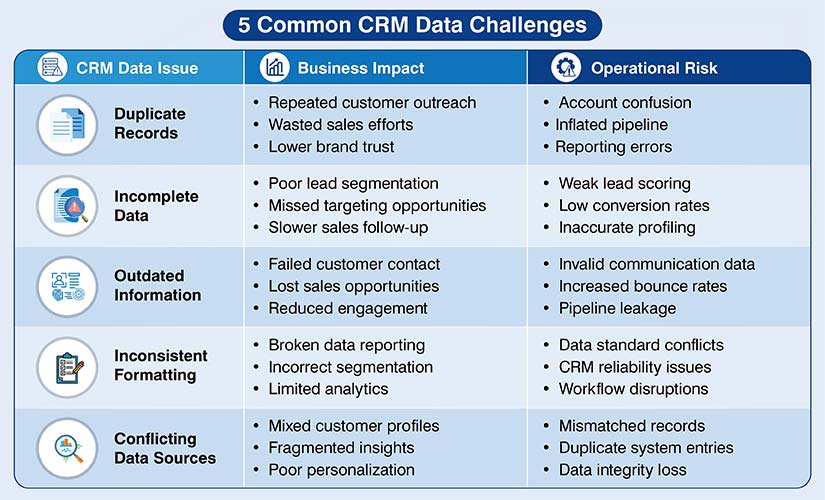
CRM data issues don’t surface overnight. Data errors keep on accumulating along with the information that flows in from sales reps, web forms, marketing tools, customer support systems, and third-party sources. Here’s a list of some of the most common CRM data issues:
- Duplicate records – The record of same customer appears multiple times, but with slightly different name or email address. Your sales representatives unknowingly might keep contacting the same client again and again, damaging brand trust and wasting precious time and efforts.
- Incomplete Data – Customer names are there in CRM but job titles, company names, phone numbers, email IDs etc. are missing against customer names. This makes it difficult to segment and prioritize the leads.
- Outdated information – Fast evolving professional environment compels people to change jobs, companies merge or move, phone numbers change and email IDs expire. If these data points are not validated, the CRM becomes a dumping ground of obsolete contacts.
- Inconsistent formatting – Sales team, customer care team, marketing team; all use their own ways to enter customer names, job titles, company size or country names. They don’t follow a standard format for entering details. This makes your CRM data unreliable and accurate analysis or reporting almost impossible.
- Conflicting data sources – Alike different teams entering customer data in various formats, data from sources like marketing, sales, and support tools also comes in a wide plethora of formats. This makes CRM records surface as mismatched records and contradictory values.
These CRM data issues slowly erode operational efficiency and decision-making. Customer records without consistency and reliability make your teams work without a single source of truth. For restoring confidence in reporting, design reliable engagement strategies, and securing long term relations with your customers, it is critical that you address these CRM data weaknesses.
Struggling with duplicate, outdated, or incomplete CRM records?
Professional CRM data cleansing to improve customer data accuracy
The business impact of dirty CRM data
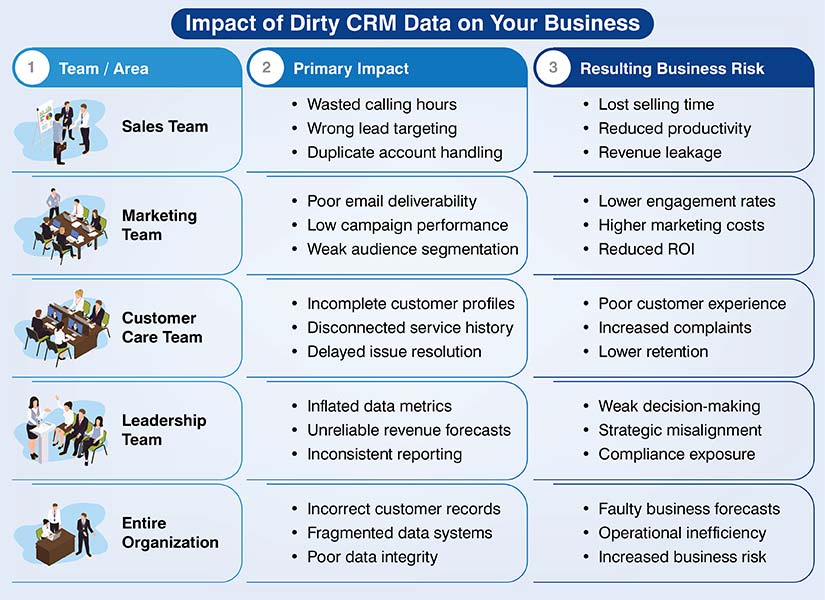
Dirty CRM data does not create just inconvenience, but it costs you time, effort, dented brand image and a lot of dollars.
- Your sales team ends up wasting numerous hours calling invalid leads, chasing wrong numbers and fixing duplicate accounts of potential customers.
- Your marketing team is baffled with lower email deliverability, low campaign performance and poor customer segmentation.
- Your business development team faces backlash due to incomplete view of the customer and disjointed interactions.
- Your leadership team keep looking for a solution to poor data quality that is inflating due to duplicates, inactive accounts, unreliable revenue projections.
- Your organization is struggling with incorrect and incomplete customer records that undermines forecasts and strategic planning and increases compliance risks.
When should you clean up your CRM data? Key warning signs
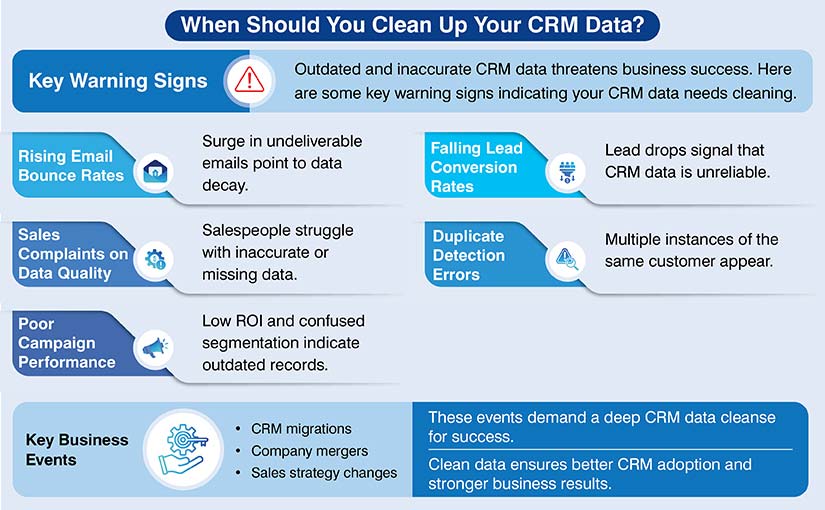
Companies waiting too long before addressing the poor CRM data quality issue are at high risk of collapsed business. They should identify the key warning signs that indicate that the CRM data clean-up is overdue.
Rising email bounce rates, falling lead conversion rates, complaints from sales team about unreliable CRM data are some of the major signs that your CRM data needs clean-up.
Duplicate detection errors, poor campaign performance and low CRM adoption are also the signs that the data is decaying and needs cleansing.
Apart form these, business events like CRM migrations, mergers, new marketing automation platforms or table turn changes in sales strategy are the times which demand deep data cleansing. No doubts that kick starting with clean, verified and validated data will significantly increase the success of this CRM data clean up initiative.
A Step-by-Step CRM data cleansing process
Cleansing a CRM database requires a structured and methodical approach. Without a clearly defined process, even well-intentioned CRM cleansing effort will fall apart. Companies that think it is a one click task are doing it all wrong, which will not yield them any results.
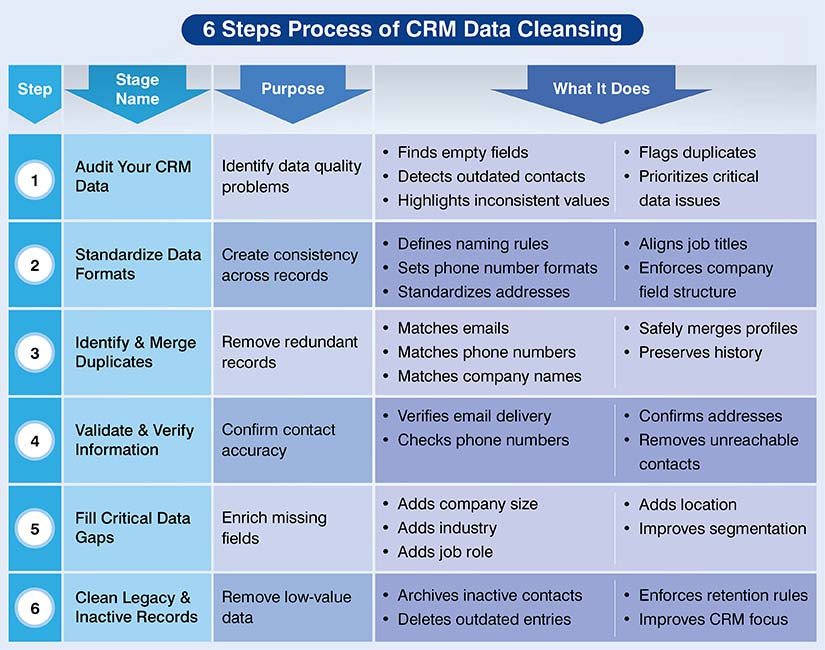
Audit your CRM data
The first step is to analyze the CRM data that you already have. Data profiling tools and CRM reports will help you to identify empty fields, outdated contacts, duplicate records and inconsistent values. This analysis will show you which data issues are severe and which data fields should be addressed with the highest priority.
Standardized data formats
The second step is to define clear standards. But do it before removing or correcting the data. Defining standard means deciding how customer names, contact numbers, their office and email addresses, job titles, and customer’s company details should be standardized in a unique format. Once decides, apply those rules across all records in your CRM database, and also ensure that future entries also follow the same structure.
Identify and merge duplicates
Match duplicate records using rules like email addresses, company name or phone numbers. Upon identifying, such records should be carefully merged so that no opportunity data or communication history is lost or gets mixed up with other records.
Validate and verify information
Use of data verification and validation services will help you check email deliverability, accuracy of contact details and postal addresses. Flag or remove invalid or not reachable contacts to strengthen marketing and sales performance.
Fill critical data gaps
Once you fix the errors, you can enrich the key data fields like company size, location, industry, job role, etc. Take up the fields that matter the most for lead scoring, segmentation and account based marketing also.
Clean legacy and inactive records
Not every record in your CRM is good and should not stay. Inactive, unresponsive and old contact data should be achieved or deleted in line with data retention and compliance policy. This keeps your CRM focused on high-value customer relations.
If executed correctly, the CRM data cleansing process will create a healthier data environment to support stronger customer relationships and smarter business decisions. With the enriched CRM records, your teams will gain clarity and instead of firefighting errors they will work with full efficiency. A well-maintained CRM is not a data storage system but is a strategic engine that continuously drives measurable business value.
Need help to clean and validate large customer databases?
Deploy CRM data specialists for cleansing, enrichment, and data deduplication
Automation and human intelligence for CRM data cleansing
CRM platforms today are equipped with basic data management features like duplicate detection, validation rules, and field standardization. But these are not enough and lack the depth required to handle voluminous and complex datasets.
Hiring expert CRM data cleansing and enrichment services can help you automate email verification, company details matching, and de-duping records. They also have the expertise to seamlessly integrate your CRM with other data sources.
But the sad part is spreadsheets are still being prepared and used for one-time cleanups or custom transformations. However, as we all know – manual approaches are not scalable and always carry the risk of introducing new errors if it is not handled correctly.
For cleaning your CRM data, the fine blend of automation and human intelligence plays a vital role and delivers the best results.
Best practices for maintaining clean CRM data
To resolve data quality problems forever, one time CRM data cleanup will not suffice. Governance and discipline are the key to sustainable CRM accuracy.
- Establish data ownership – Assign responsibility for data accuracy
- Enforce data standards – Use validation rules and mandatory fields
- Train CRM users – Educate teams on correct data entry
- Schedule regular audits – Review data monthly or quarterly
- Clean and update records – Remove errors before they spread
Schedule and adhere to regular data audit and data cleansing regime. It can be monthly, quarterly or twice in a year, depending on the volume of your data. The goal is to identify and resolve problems early before they spread.
How often should you clean your CRM Data
Data decay is constant. B2B data has the tendency to degrade 20% year on year and the B2C data also does not fall short when it comes to degrading. This also indicates that even perfectly clean CRM data is running towards decaying withing months, if not maintained regularly.
Regular deep cleans and automated data checks have proven its worth for a lot of organizations. A structured approach to data cleansing for B2B companies, along with monthly validation, quarterly deduplication, and annual audits, helps create a strong data hygiene framework.
In-House vs outsourced CRM data cleansing
Small and medium size businesses often try to clean up CRM data internally. But this DIY approach comes with its own limitations. Sales and marketing teams are deployed for the task, who are absolutely no data specialists. Manual cleanup consumes time that these teams should be spending on revenue-generating activities.
Expert CRM data cleansing services are equipped with advanced tools, trained analysts, and robust data cleansing workflows. They have hands on experience of cleansing millions of records quickly, validating data against multiple resources with high accuracy, and enforcing strict quality controls. For organizations with large, complex databases, outsourcing data cleansing is the most cost-effective and reliable solution if compared to internal efforts.
How clean CRM data drives revenue growth
Clean CRM data oils every single part of the revenue engine. Now your sales teams work in steam rolling mode with the help of accurate leads and complete customer profiles. Marketing campaigns are derived to target the correct audiences with personalized messages.
Your forecast now showcase reality instead of guesswork and assumptions. Your customer care teams gain a 360 degree view of every relationship. All these leads to better customer experiences, higher conversion rates, and stable long-term growth.
Final thoughts
Clean data helps in building trust. Today’s modern data driven businesses thrive on trust that turns customer information into revenue. Any organization’s CRM is only as powerful as the data it is updated with. In absence of regular cleansing, even the best of the CRM platforms become inefficient and unreliable. It’s time companies invest in regular data cleansing, validation and enrichment to turn their CRMs into a single source of truth that work as a competitive advantage.
Ready to transform your CRM into a reliable source of customer intelligence?
CRM data cleansing to improve data quality, customer insights, and business growth.